Void Fire Detection Solutions for Ceiling Voids, Raised Floors and Concealed Spaces
Article Body
In many buildings, fire risk does not only exist in visible occupied rooms. Fire can also start in hidden spaces such as suspended ceiling voids, raised floors, cable spaces, utility shafts, electrical service areas and HVAC return air spaces.
These areas are often difficult to access after construction. They may contain electrical cables, control wiring, communication lines, insulation materials or air movement paths. If smoke or heat develops inside these concealed spaces, normal room-mounted detectors may not provide the earliest warning.
For this reason, void fire detection should be considered as a dedicated application, not just a standard detector installation. ANWETECH provides practical solutions for ceiling voids, raised floors and concealed spaces using aspirating smoke detection and linear heat detection cable.
Void fire detection refers to smoke or heat detection installed for hidden or hard-to-access spaces inside a building or industrial facility.
Typical protected areas include:
Suspended ceiling voids
Raised floor areas
Data center underfloor spaces
Server room cable spaces
Electrical cable trays
Cable tunnels and cable routes
HVAC return air spaces
Utility shafts and service voids
Concealed industrial equipment spaces
The purpose is to detect early smoke or heat in areas where fire may develop before it becomes visible in the occupied room.
Ceiling voids and raised floors are common in modern commercial buildings, data centers, telecom rooms, control rooms and industrial facilities. These spaces are often used for cable routing, ventilation, power distribution or equipment services.
The main fire detection challenges include:
Limited access for inspection and maintenance
Hidden cable fire risks
Air movement that may affect smoke behavior
Long and narrow protected areas
Difficulty using standard point detectors in every position
Need to connect alarm signals to a fire alarm control panel or BMS system
A good void fire detection design should consider both detection performance and long-term maintenance.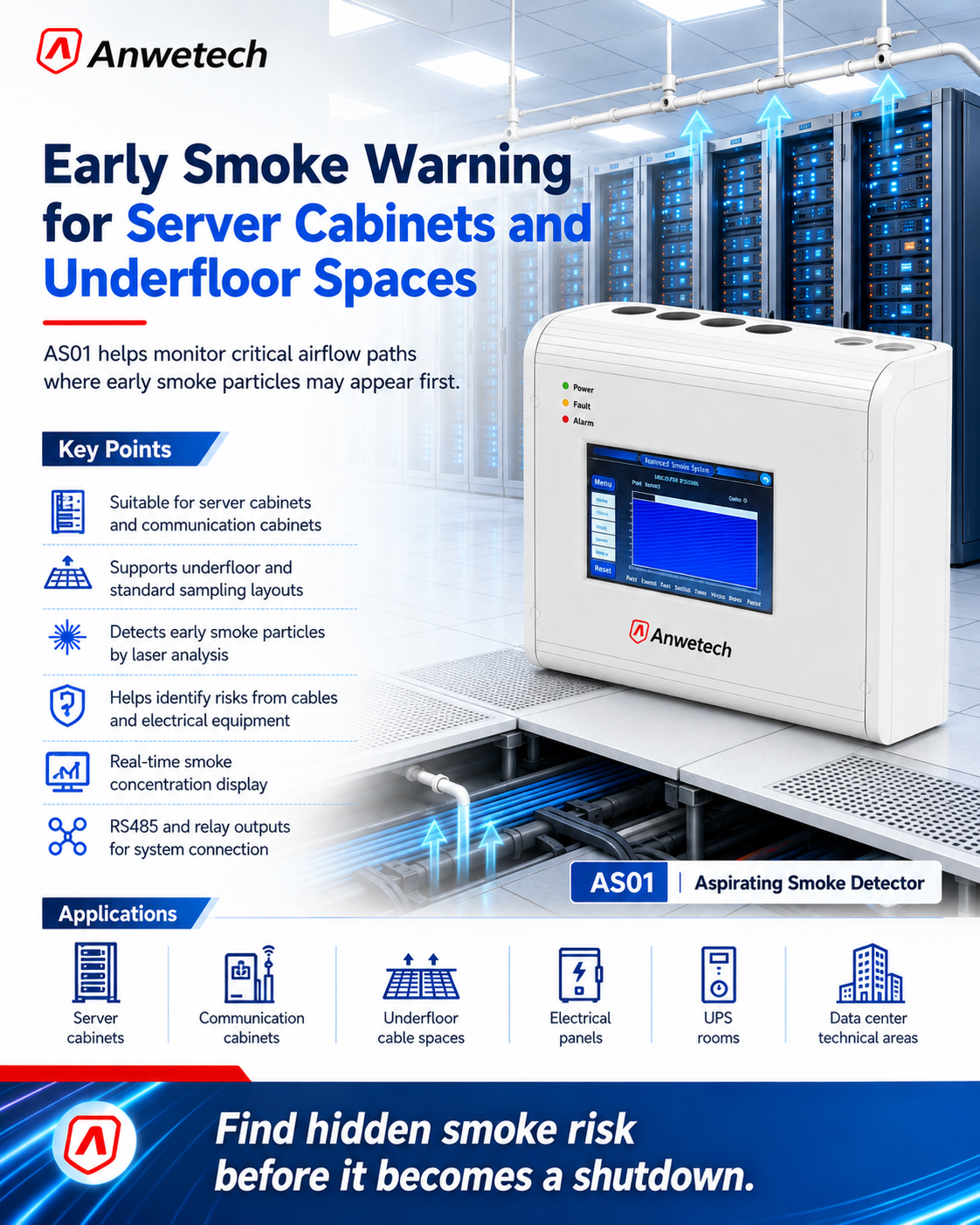
For applications where early smoke detection is important, ANWETECH recommends the AT-AS01 Stand-alone Laser Cavity Aspirating Smoke Detector.
The AT-AS01 system actively draws air samples from the protected area through a sampling pipe network. The detector analyzes smoke particle concentration and triggers alarms according to preset thresholds.
This makes aspirating smoke detection suitable for applications where smoke may develop in hidden spaces before it reaches the room area.
AT-AS01 is suitable for:
Data center raised floors
Server room underfloor spaces
Telecom equipment rooms
Electrical rooms
Cable tunnels
Battery rooms
Warehouses
Laboratories
Museums and archive areas
Other critical facilities requiring early smoke warning
Aspirating smoke detection is especially useful for void fire detection because the detector unit can be installed in an accessible location, while the sampling pipe network extends into the hidden space.
This design helps solve several engineering problems:
The detector can be maintained without entering the entire void space
Sampling holes can be arranged along the protected area
Smoke concentration can be monitored continuously
Alarm and fault signals can be integrated with a fire alarm control panel
Different alarm levels can support staged response
For data centers and server rooms, this is especially important because smoke from overheating cables or electrical equipment may appear under the raised floor before it is visible in the room.
For long, narrow or cable-intensive concealed spaces, ANWETECH recommends AT-LH Linear Heat Detection Cable.
Linear heat detection cable is installed along the risk area. When the temperature reaches the rated alarm temperature, the cable provides a heat detection signal through the system interface.
This solution is practical for cable routes, cable trays, industrial equipment spaces and other areas where heat detection along a continuous path is required.
AT-LH Linear Heat Detection Cable is suitable for:
Cable trays above suspended ceilings
Raised floor cable routes
Cable tunnels
Cable basements
Conveyor areas
Industrial equipment spaces
Power distribution areas
Utility corridors
Confined concealed spaces
ANWETECH AT-LH series provides multiple rated alarm temperature options, including:
68°C
88°C
105°C
138°C
180°C
This allows engineers to select a suitable temperature rating according to the protected environment, normal ambient temperature and fire risk level.
A complete linear heat detection cable system can include:
AT-LH Linear Heat Detection Cable
AT-LHMI Adapter Unit
AT-LHME Termination Unit
Fire alarm control panel or input module connection
The AT-LHMI adapter unit provides the interface for the heat sensing cable circuit, while the AT-LHME termination unit provides end-of-line termination at the circuit end.
Both aspirating smoke detection and linear heat detection cable can be used for void fire detection, but they solve different problems.
Very early smoke warning is required
The protected area is a data center, server room or telecom room
Smoke detection is preferred before significant heat develops
The detector should be installed in an accessible location
Continuous air sampling is needed
Multiple alarm levels and monitoring functions are useful
The main risk is cable overheating or localized heat
The area is long, narrow or difficult to access
The installation follows cable trays or cable routes
A cost-effective long-distance detection method is required
Heat detection is more suitable than smoke detection
The project needs a simple and rugged detection method
In many projects, both solutions can be used together. For example, AS01 can provide early smoke detection in a data center raised floor, while linear heat detection cable can protect cable trays, cable routes or electrical service areas.
Void fire detection systems should not operate as isolated devices. They should be connected to a fire alarm control panel, addressable module, conventional zone or monitoring system according to the project design.
ANWETECH solutions can support system integration through:
Alarm relay output
Fault output
Reset input
RS485 communication
Input module connection
Conventional or addressable fire alarm system interface
Remote monitoring or BMS integration where required
For engineering projects, the final connection method should follow the approved fire alarm system design, local code requirements and site commissioning plan.
A typical ceiling void solution may include:
AT-AS01 Aspirating Smoke Detector installed in an accessible service area
Sampling pipe network installed inside the ceiling void
Sampling holes arranged according to the protected layout
Alarm and fault outputs connected to the fire alarm control panel
Optional linear heat detection cable installed along cable trays or high-risk routes
System testing and maintenance access planned from the beginning
This design allows the hidden space to be protected without requiring every detector to be physically mounted deep inside the void.
A raised floor fire detection solution may include:
AS01 aspirating smoke detector for early smoke warning
Sampling pipes installed below the raised floor
Sampling points arranged near cable routes, power distribution areas and airflow paths
Alarm levels configured according to project requirements
Linear heat detection cable used along high-risk cable routes if heat detection is needed
Connection to the main fire alarm control panel or monitoring system
This is suitable for data centers, server rooms, control rooms and telecom facilities.
ANWETECH void fire detection solutions help engineers and contractors design practical protection for hidden spaces.
Main benefits include:
Suitable for ceiling voids, raised floors and concealed spaces
ASD and LHD options for different fire risks
Early smoke detection for mission-critical areas
Linear heat detection for cable routes and long concealed areas
Multiple alarm and fault interface options
Compatible with fire alarm system integration
Practical installation and maintenance planning
Suitable for commercial, industrial and infrastructure projects
Recommended for:
Data center underfloor smoke detection
Server room early warning
Telecom room smoke detection
Ceiling void smoke detection
HVAC or concealed air sampling applications
Critical facility smoke monitoring
Recommended for:
Cable tray fire detection
Cable tunnel heat detection
Raised floor cable route protection
Ceiling void cable protection
Industrial long-distance heat detection
Concealed electrical space protection
Recommended for:
Linear heat detection cable circuit interface
End-of-line termination
Fire alarm system connection
Engineering project installation
ANWETECH void fire detection solutions can be used in:
Data centers
Server rooms
Telecom rooms
Control rooms
Electrical rooms
Commercial buildings
Office buildings
Shopping malls
Hospitals
Airports
Railway stations
Warehouses
Industrial plants
Power facilities
Cable tunnels
Museums and archives

