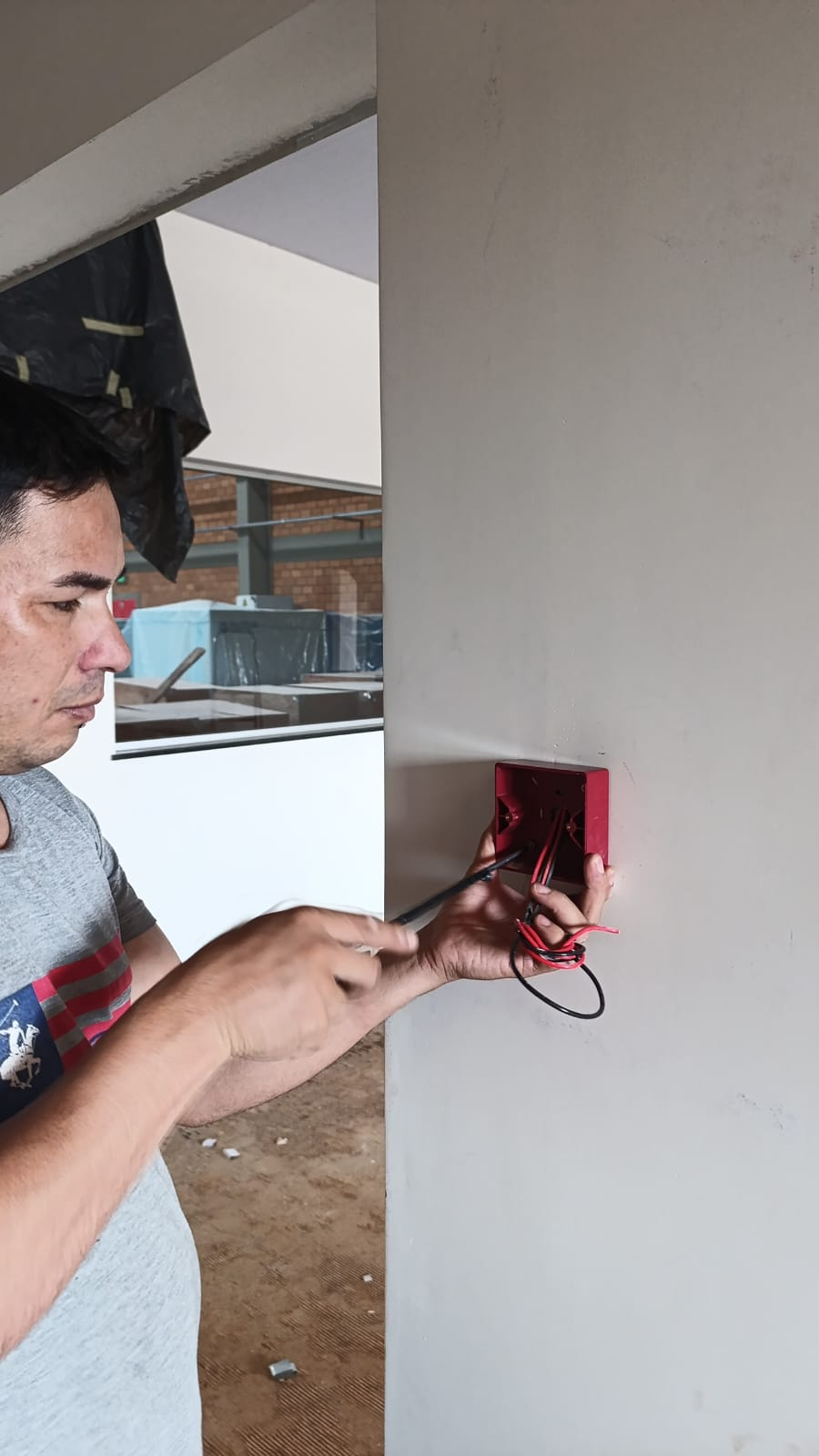
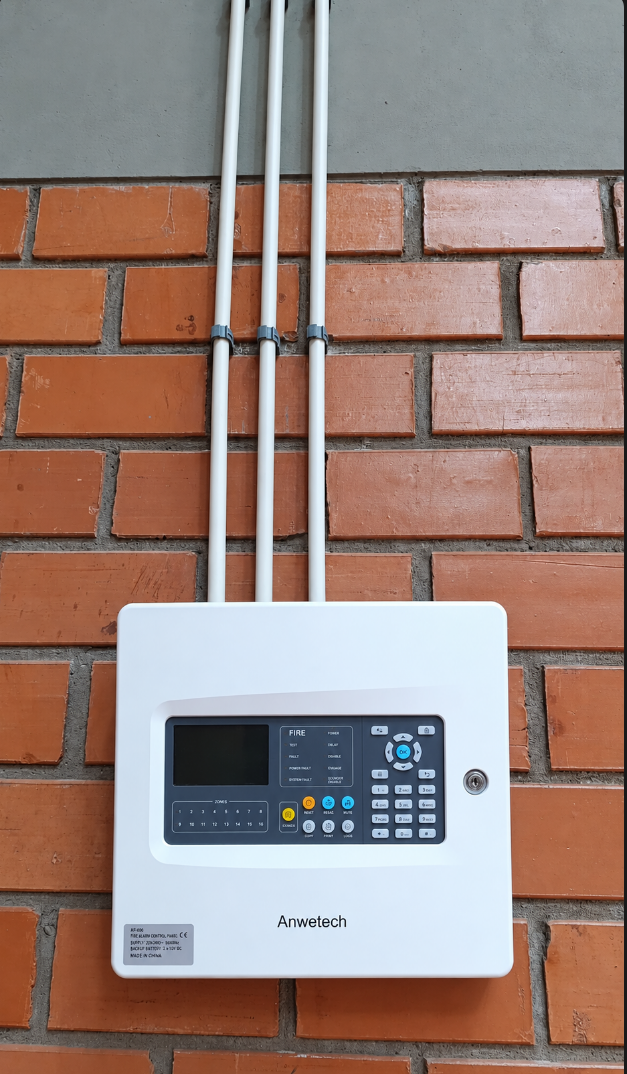
ANWETECH provided a single-loop addressable fire detection system for a building project located on Ruta 7, Hernandarias, Alto Paraná, Paraguay.
The system is centered on the AT-F101 fire alarm control panel and combines automatic smoke detection, heat detection, manual alarm initiation, and audible/visual alarm notification.
The installed product configuration includes S101 smoke detectors, H101 heat detectors, M101 manual call points and SS102 sounder strobes, providing the main field-device functions required for a structured building fire detection and alarm system.
The AT-F101 is a one-loop addressable fire alarm control panel supporting up to 120 addressable points, allowing compatible field devices to be registered and managed within the same system. ANWETECH_AT-F101_Installation_C…
| Item | Project Details |
|---|---|
| Project | Ruta 7 Building Fire Alarm Project |
| Location | Ruta 7, Hernandarias, 100523, Alto Paraná, Paraguay |
| Country | Paraguay |
| Application | Building Fire Detection and Alarm |
| System Type | Addressable Fire Detection and Alarm System |
| Main Control Panel | ANWETECH AT-F101 |
| Smoke Detection | S101 Smoke Detector |
| Heat Detection | H201 Heat Detector |
| Manual Alarm | M101 Manual Call Point |
| Alarm Notification | SS102 Sounder Strobe |
| Quantity | Not specified |
| Protection Area | Not specified |
A building fire alarm system needs more than one method of alarm initiation.
Smoke detectors provide automatic detection for conditions where smoke is produced during the early development of a fire, while heat detectors provide another detection method for locations where temperature rise is an appropriate alarm criterion.
Manual call points allow occupants or personnel to manually initiate a fire alarm when a fire is identified, while sounder strobes provide alarm notification after system activation.
For the Hernandarias project, these functions are combined into one addressable system rather than relying on a single type of initiating device.
This creates a coordinated architecture covering:
No project-specific detector spacing, quantities or protection-area dimensions have been provided, so these values are not added to the project case.
The AT-F101 provides the central control platform for the project.
According to the technical manual, it is an addressable fire detection panel with one loop supporting up to 120 addressable points. The panel monitors input signals, provides system status indications and activates outputs according to programmed logic.
The system architecture also supports the device categories required by this project, including optical detectors, heat detectors, manual call points and sounder strobes.
This makes the AT-F101 suitable as the central platform for integrating the different detection and notification devices included in the Ruta 7 building project.
The project uses a straightforward addressable fire detection architecture:
S101 Smoke Detector / H201 Heat Detector / M101 Manual Call Point
↓
Addressable Detection Loop
↓
AT-F101 Fire Alarm Control Panel
↓
Alarm Processing and Programmed Logic
↓
SS102 Sounder Strobe / System Outputs
Each addressable device can be registered with a unique address and assigned to the appropriate zone during commissioning.
The AT-F101 commissioning interface allows engineers to assign product type, device type, zone and output mode according to the approved project design. ANWETECH_AT-F101_Installation_C…
The exact cause-and-effect configuration used for this building has not been provided and is therefore not stated in this project article.
The AT-F101 serves as the main fire alarm control panel for the project.
Confirmed characteristics from the installation and commissioning manual include:
The loop can be configured for either Class A or Class B wiring depending on the approved installation design. ANWETECH_AT-F101_Installation_C…
S101 smoke detectors provide the smoke-detection element of the system.
They are connected as part of the addressable fire detection architecture and report alarm conditions to the AT-F101 control panel.
No additional sensitivity, spacing, certification or environmental parameters are stated here because those details were not included in the technical information supplied for this project article.
H101 heat detectors provide heat detection within the building fire alarm system.
Using smoke and heat detection devices within the same overall system allows the project design to apply the appropriate detector type according to the requirements of each protected location.
M101 manual call points provide a manual means of initiating a fire alarm.
They form part of the addressable field-device configuration monitored by the AT-F101 panel.
SS102 sounder strobes provide the alarm-notification function within the project configuration.
The AT-F101 system supports sounder and sounder-strobe device categories as part of its field-device architecture. ANWETECH_AT-F101_Installation_C…
Proper commissioning is particularly important for an addressable system because every field device must be correctly registered and assigned within the system configuration.
The AT-F101 provides a Loop Learn function that automatically registers addressable devices connected to the loop. Engineers can then configure device addresses, product types and zones as required.
The panel also includes commissioning tools for checking duplicate addresses, zone testing and point testing. These functions help engineers verify individual field devices and system configuration during commissioning.
Final detector positions, loop routing, alarm logic and notification coverage must follow the approved project design and applicable local requirements.
The Ruta 7 project demonstrates how a compact addressable platform can combine several essential fire alarm functions within one coordinated system.
Instead of using separate independent detection and notification devices, the configuration brings together:
Detection → Manual Alarm → Central Control → Alarm Notification
The combination of the AT-F101 panel with S101 smoke detectors, H201 heat detectors, M101 manual call points and SS102 sounder strobes provides a clear system architecture for building fire detection and alarm monitoring.
Because devices are addressable, they can be registered and assigned individually during system commissioning rather than being treated only as conventional zone devices.
A similar AT-F101 configuration can be considered for building projects requiring:
Final system capacity, detector quantities, spacing, alarm logic and notification-device layout should always be determined according to the actual building design and project requirements.
